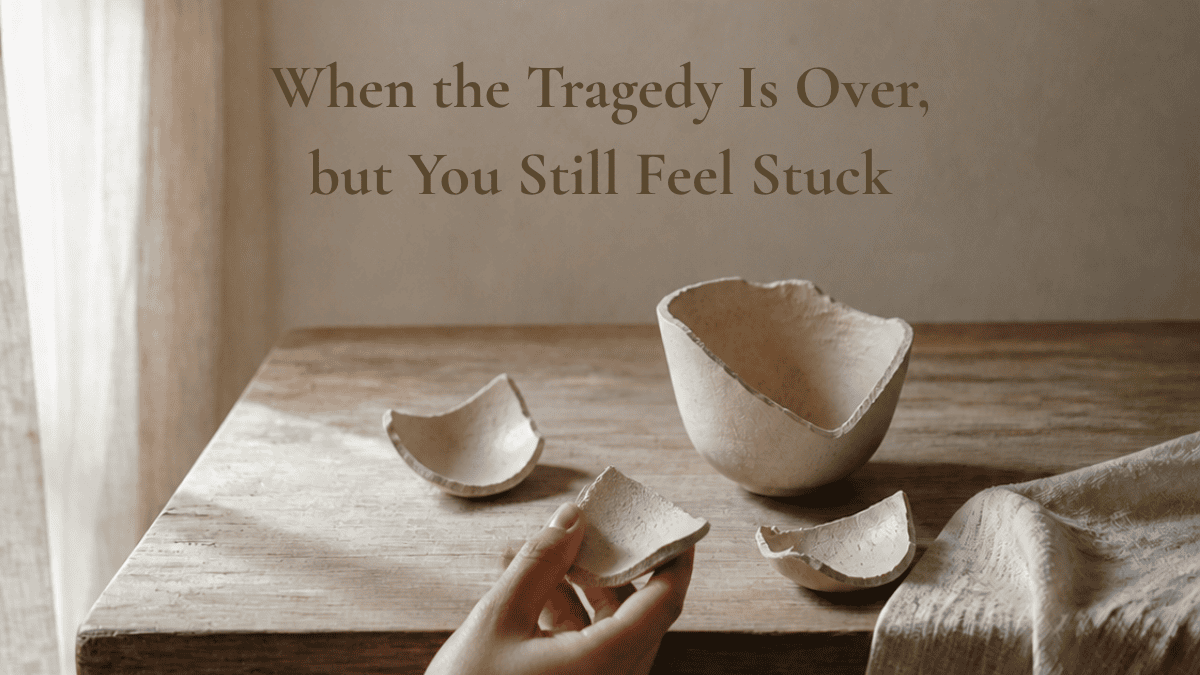
When the Tragedy Is Over, but You Still Feel Stuck
Sometimes the crisis ends before our hearts realize it is over.
Life around us begins moving again. People return to their routines, and they may assume we are doing the same.
Perhaps, on the outside, we are.
We get up. We handle our responsibilities. We smile when expected and tell people we are doing okay.
Inside, part of us may still be living in what happened.
Certain places, dates, or conversations pull us back. Fear influences decisions that once felt simple. Relationships feel different. Our confidence, faith, or sense of safety may have changed.
We survived, but we do not feel free.
We may begin to think this is simply who we are now. But what feels like being permanently stuck may be a part of our story that has never had the chance to be understood.
Looking at What Happened
During a tragedy, we often focus on getting through it. We make the next decision, face the next day, and do whatever the moment requires.
There may not be time—or emotional space—to sort through everything we are feeling.
Later, when the immediate crisis has passed, the feelings can remain tangled together. Fear, anger, grief, guilt, disappointment, and loss can become one heavy burden we simply call pain.
It is difficult to know what needs attention when we cannot see the individual pieces.
That is why telling the story matters.
When you write what life was like before, what you experienced during the event, and what has changed since, patterns can begin to emerge. You may notice a feeling you have never named or recognize that a decision you keep making is connected to something that happened long ago.
You are not writing the story to remain inside it.
You are trying to understand what you are still carrying from it.
Naming the Pieces
After the story has been written, it can be read again from a little distance.
Not all at once. A paragraph or two may be enough.
As you read, certain words, phrases, feelings, or repeated themes may stand out.
Perhaps you wrote that you are afraid all the time. The next question is not simply whether you are afraid, but what you are afraid of.
Are you afraid of being alone? Afraid to trust again? Afraid that what happened before will happen again?
Perhaps anger appears throughout the story. Who are you angry with, and why? Is some of that anger directed toward God?
A broken piece may be a relationship, confidence you once had, a dream you lost, or a sense of safety that never fully returned.
Naming the piece does not repair it. It helps you see what is actually there so you are not trying to heal one large, undefined wound.
Deciding What Is Worth Restoring
Once a piece has been identified, another question follows:
Does this piece belong in the life I am building now?
Our first instinct may be to put everything back exactly as it was. We want the old life, the old relationship, or the person we remember being.
But not everything we had before the tragedy was necessarily healthy or beneficial. Some relationships may be worth restoring. Others may not be. Some things mattered deeply but cannot be recovered, no matter how much we want them back.
For each piece, we can ask:
Is this worth salvaging?
Would restoring it play a positive role in my life?
Why is it important to me?
Do I have any control over restoring it?
Can I still become whole without it?
The answers may be different for each piece. They may also take time.
Letting go of something does not mean it never mattered. It may mean accepting that wholeness cannot depend upon returning life to exactly what it was.
Making a Plan
For the pieces you choose to restore, the next step is practical.
If the piece is a relationship, your action might be writing a letter, offering an apology, or asking someone to meet for a conversation.
If the piece is confidence, your action may be doing one thing you stopped doing because fear took its place.
If the piece is beyond your control, the work may involve grieving what cannot be restored and considering what you need in order to move forward.
The plan should include prayer—not as a promise that the result will be exactly what you want, but as a place to ask God for courage, wisdom, and direction.
The action belongs to you.
The result may not.
That distinction matters. You can take responsibility for your part without carrying responsibility for another person’s choices or for circumstances you cannot change.
Pause & Reflect
Think about one place where you still feel stuck.
Ask yourself:
What is one broken piece connected to this part of my story?
Try to name it as clearly as possible.
Then consider:
- Why is this piece important to me?
- Would restoring it play a positive role in my life?
- Do I have any control over its restoration?
- Can I still become whole if it cannot be restored?
If you decide it is worth working on, write down one action that is within your control.
Then pray honestly about that action and the result you hope for.
You do not have to work through every piece today. Begin with the one you can see.
From the Founder’s Heart
Picking Up the Broken Pieces was created for the person who has passed through the initial shock and anguish of tragedy but still cannot find the way forward.
When everything has become one large burden, it can feel impossible to lift. The workbook slows the process down. It helps you tell your story, identify what was broken, and examine one piece at a time.
Some pieces may be worth restoring. Some may need to be released. Others may have to be grieved because their restoration is outside your control.
I cannot tell you which is which. That is personal work between you and God, and it may require time, prayer, and support.
What I can offer is a place to begin.
Not with every piece.
With one.
—Patrice
A Gentle Invitation
Picking Up the Broken Pieces provides a guided process for the person who is no longer in the immediate aftershock of tragedy but still feels stuck in what happened.
You will begin by writing your story before, during, and after the event. Then you will identify and define the individual pieces, decide which are worth keeping, and create an action plan and prayer for those you are ready to address.
The work can be done privately and at your own pace. If recounting the experience remains overwhelming, the workbook encourages you to take the time you need and seek appropriate professional or community support.
If you feel ready to look at your story from a little distance and begin examining one piece at a time, you can learn more here: